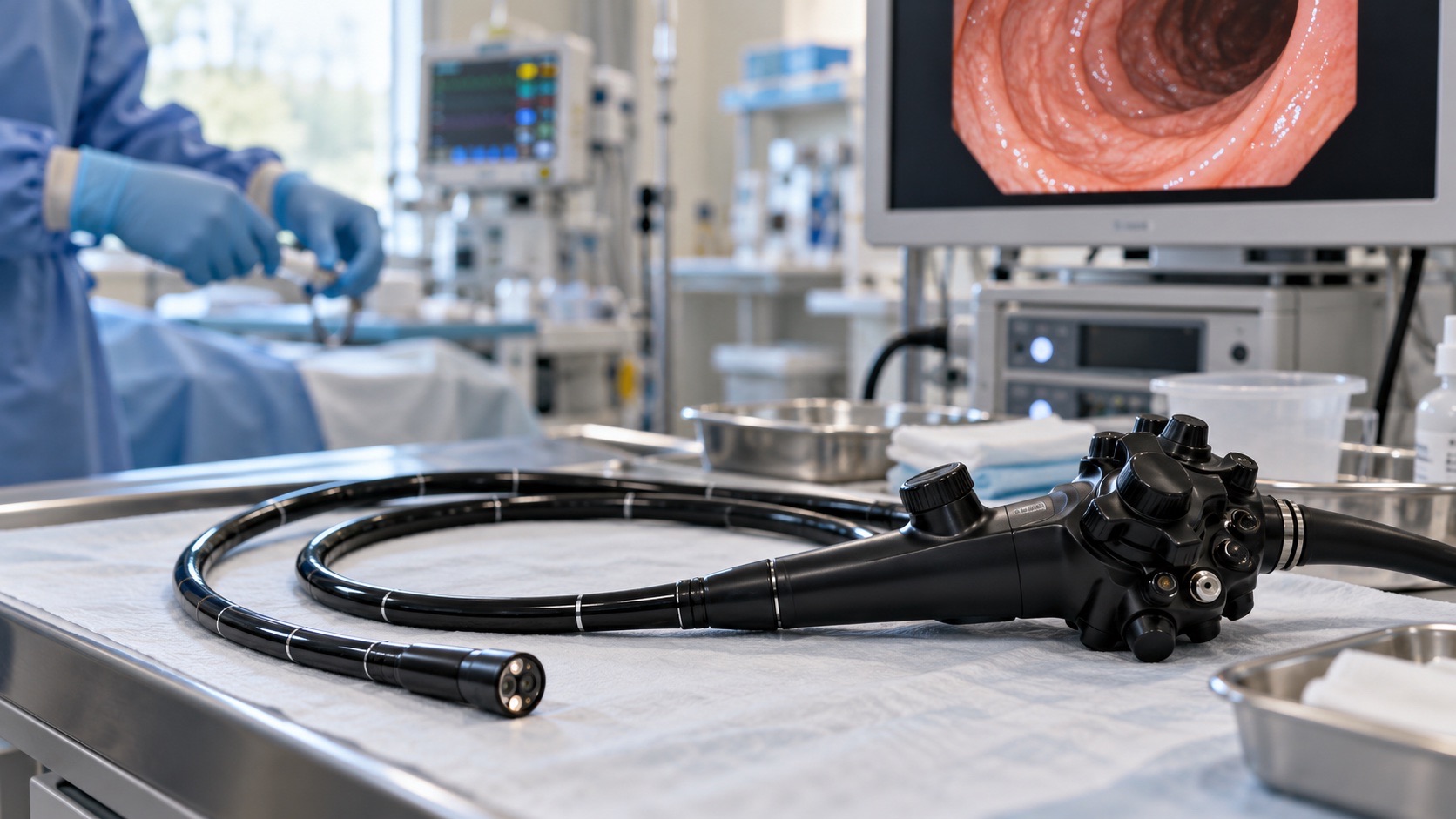
Most evidence points to 200 to 250 supervised upper endoscopies, but a bare count is a weak yardstick. A US benchmark study of fellows found overall competence at an average of about 250 procedures (Miller et al., 2019).
How many upper endoscopies to be competent, skill by skill
In that study of 96 fellows, competence meant an average ACE-E score of 3.5 plus independent D2 intubation at least 95% of the time within 4.75 minutes. Fellows met the D2 criteria at around 100 to 150 procedures, but most other thresholds took 200 to 250, and recognition of pathologic states took 300 (Gastrointestinal Endoscopy, 2019; full text).
A UK national analysis of 243,555 upper GI endoscopies found trainees reached 95% unassisted D2 completion at 187 procedures, and over 90% had reached it after 200 (Gut, 2017). That makes 200 procedures a reasonable floor for intubation alone.
Society minimums side by side
Published minimums run from 130 to 1,000 depending on the body (2023 systematic review).
| Body (year) | Upper endoscopy minimum |
|---|---|
| ASGE, US (2017) | 130, plus 95% pylorus intubation |
| CAG, Canada (2008) | 150 (100 unassisted) |
| Conjoint Committee, Australia (2015) | 200 supervised |
| New Zealand (2022) | 200 supervised |
| JAG, UK (2022) | 250 (190 unassisted) |
| Switzerland (2013) | 400 supervised |
| KSGE, Korea (2017) | 1,000 |
The older ASGE figure of 130 was a minimum before assessment, and a commentary on the US data suggests competence may take nearly double that (Kolb and Wagh). The 2023 review found D2 intubation rate the only consistent quality indicator across most guidelines (review), so a logbook total is a floor, not proof. The validated ACE tool was completed after every 50 procedures in its validation study (source).
Emergency bleeding and advanced procedures
A single-centre study of 787 bleeding cases suggested at least 20 emergency EGDs with recent haemorrhage before independent work, though its authors note the thresholds come from one centre (2024 study). Advanced procedures run higher: about 225 cases for core EUS and 250 for ERCP (trainee study).
What this means for a trainee in Egypt
No Egyptian source reviewed here sets an upper-endoscopy count, so these are international benchmarks. Confirm your own programme's logbook requirement and use these numbers to read it, not replace it.
The WGO Cairo Training Center at the Theodor Bilharz Research Institute describes a three-level pathway (diagnostic, therapeutic, advanced) in a unit it says handles about 140 to 150 procedures a week. Fees for a short hands-on course are covered in what doctors pay for an upper GI endoscopy course in Egypt.
What a short course covers and what is not included
A short hands-on course adds technique, not counts: Dextrology's Upper GI Endoscopy course runs 19 to 21 November 2026 at Kasr Al Ainy, Cairo, with Prof. Dr. Mahmoud Wahba and one-to-one supervision on a real patient. It does not replace a logbook and grants no clinical privileges.
The evidence above points to the right way to use one: keep logging supervised procedures, and have each block of about 50 scored with a validated tool, as the ACE validation study did, so technique practice feeds a measured record instead of a bare total.
Next step
By Dr. Omar Yasser, Licensed Physician. To compare formats and dates, Explore Dextrology courses. Before you rely on any count in this article, ask your programme director how logbook entries are signed off, whether procedures are scored with a structured tool, and which skills, such as D2 intubation, are assessed separately. Whatever you choose, your programme's logbook and assessments remain the record of competence.